
The Future of Customer Experience Isn't Human or AI
Tag: CX Insights & Trends
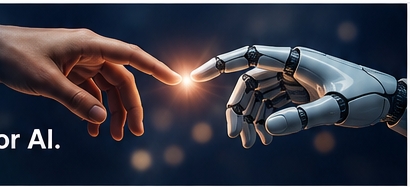
It's Human + AI
For several years, the debate around artificial intelligence in customer service has been framed as a competition: human or machine.
That framing is becoming less useful.
Customers do not wake up hoping to speak to a human agent, nor do they necessarily want an automated interaction. They want their problem understood and resolved with as little effort as possible. Sometimes technology is the best way to achieve that. Sometimes a person is. Increasingly, the strongest experience will involve both.
The real opportunity is not choosing between humans and AI. It is redesigning customer service around the strengths of each.
Customers want resolution, not a channel philosophy
Customer experience teams often think in channels, operating models and technology categories. Customers usually do not.
A customer trying to change a delivery, understand a charge or solve an account problem is focused on the outcome. If an AI agent can resolve the issue immediately and accurately, that may be the best experience. If the situation is emotional, unusual or consequential, the customer may value human judgement much more.
The problem begins when organisations force one model onto every interaction.
Poor automation traps customers in loops. Poorly designed human service makes customers wait for simple answers. Fragmented service forces people to repeat information every time the channel or agent changes.
A better model begins with the nature of the customer need and then decides how technology and people should contribute.
AI should remove work, not humanity
One of the most valuable uses of AI may be almost invisible to the customer.
Customer service agents spend significant time on work that does not require their uniquely human capabilities. They search knowledge bases, switch between systems, take notes, summarise conversations, complete after-call administration and look for the next best action.
When AI can handle more of that cognitive and administrative load, the agent can pay greater attention to the person in front of them.
Five9's AI Agent Assist is designed to provide real-time intelligence and automation, including guidance and automated summaries, so agents can spend less time on repetitive work and more time solving customer issues.
This is an important shift in how organisations think about productivity. The objective is not only to make each interaction shorter. It is to make the human minutes in an interaction more valuable.
The human role becomes harder as routine work disappears
There is a paradox in the move towards automation. The more successfully organisations automate simple contacts, the more difficult the remaining human conversations may become.
Agents will increasingly receive exceptions, escalations and emotionally charged situations. They may deal with customers who have already tried self-service and are frustrated that it did not work. They may need to interpret policy, balance commercial considerations, show empathy and make judgement calls that do not fit a standard script.
This means the future agent may require more skill, not less.
Organisations will need to rethink recruitment, training, coaching and empowerment. If AI takes away the predictable work, people need to be prepared for the unpredictable work.
Technology can support them, but it cannot compensate for an operating model that gives agents no authority, poor information or rigid processes.
The handoff is where hybrid CX succeeds or fails
The phrase 'human plus AI' sounds simple until a customer moves from one to the other.
That transition is one of the most important design moments in modern customer service.
If an AI agent has already authenticated the customer, understood the problem and attempted several actions, the human agent should not begin by asking, 'How can I help you today?'
Context must move with the customer. The human should be able to see what has already been discussed, what information has been gathered and what the AI has attempted.
This is not a minor operational detail. It directly shapes trust. Five9's 2026 research found a striking gap between how organisations assess handoffs and how customers experience them: most decision-makers said context is preserved, while 83% of consumers said they still have to repeat themselves at least sometimes after a transfer.
The lesson is simple. A hybrid model is only as strong as the connection between its parts.
AI can make service more personal, if the organisation knows the customer
Personalisation is often discussed as an AI capability, but AI cannot create meaningful personalisation from disconnected or unreliable information.
To respond intelligently, systems need access to relevant context: what the customer owns, what has happened before, what they are trying to achieve and what the organisation is permitted to do.
That places data, knowledge and workflow design at the centre of the AI conversation.
An AI agent that sounds natural but cannot access the information needed to solve the problem is still a poor experience. A human agent equipped with incomplete context faces the same limitation.
The future of CX therefore depends not only on better models, but on connecting intelligence to the systems, knowledge and processes where customer outcomes are actually created.
Trust requires transparency and choice
Customers are becoming more comfortable with AI, but comfort should not be confused with unconditional preference.
Five9's 2026 research across the United States, United Kingdom and Germany found that 80% of consumers were willing to use AI-powered customer service, while two-thirds still preferred speaking with a human. It also found that 71% considered it very or extremely important to know when they were interacting with an AI agent.
Those findings point towards a practical principle for CX design: customers should not have to choose between innovation and control.
AI can provide speed and availability. Human support can provide judgement and reassurance. Transparency helps customers understand which they are receiving. Choice gives them confidence that they can reach a person when the situation warrants it.
Trust is not created by hiding the technology. It is created by designing the experience around the customer's needs.
The best operating model will be dynamic
The future is unlikely to be a neat split in which AI handles simple contacts and humans handle complex ones. Customer needs change during an interaction.
A conversation may begin as a routine request and become sensitive. An AI agent may solve most of a task but require a human to approve an exception. A human agent may lead the conversation while AI works quietly in the background, finding information, suggesting next steps or preparing a summary.
The most effective organisations will therefore build a dynamic model in which responsibility can move between AI and people without creating friction for the customer.
That requires more than technology. It requires clear decision rights, well-designed workflows, strong knowledge management, governance, measurement and a culture that treats AI as part of the operating model rather than a separate innovation project.
The competitive advantage is orchestration
As access to AI becomes more widespread, simply having AI will stop being a differentiator.
The advantage will come from orchestration: knowing which work should be automated, which decisions need human judgement, how context moves between the two and how every interaction contributes to a better understanding of the customer.
Five9 describes this direction as a unified human and AI workforce, with AI agents and human agents working on one platform and context preserved across handoffs.
The broader idea matters for every CX leader. The goal is not to make service feel more automated. It is to make it feel more capable.
The future of customer experience is not human or AI. It is a partnership in which technology handles what technology does best, people focus on what people do best, and the customer experiences one connected organisation.
MEET FIVE9 IN AMSTERDAM
This human and AI partnership will be a central theme in Amsterdam at the 12th Unleashing Digital Customer Experience & Customer Service Summit on 2–3 November 2026.
Five9 is one of the main Knowledge Partners of this year's edition and will join senior Customer Experience, Customer Service, Digital, AI and Transformation executives from leading organisations across industries.
The summit creates space for the conversations that are difficult to have in a webinar or sales presentation: what should we automate, where should humans remain central, how do we preserve trust and what does a genuinely connected customer journey look like?
Attendees will be able to meet the Five9 team, exchange perspectives on intelligent CX and build relationships with top-level senior executives from different industries. For organisations moving from AI experimentation towards real operational change, those cross-industry conversations can be particularly valuable.
Join the conversation in Amsterdam and explore not simply what AI can do, but how humans and AI can work together to create customer experiences people actually value.